The following newspaper articles from 1921-1929 provide background details on the history of claims by two different women that they were the surviving Grand Dutchess Anastasia.
WELLSBORO AGITATOR
SEPTEMBER 28, 1921
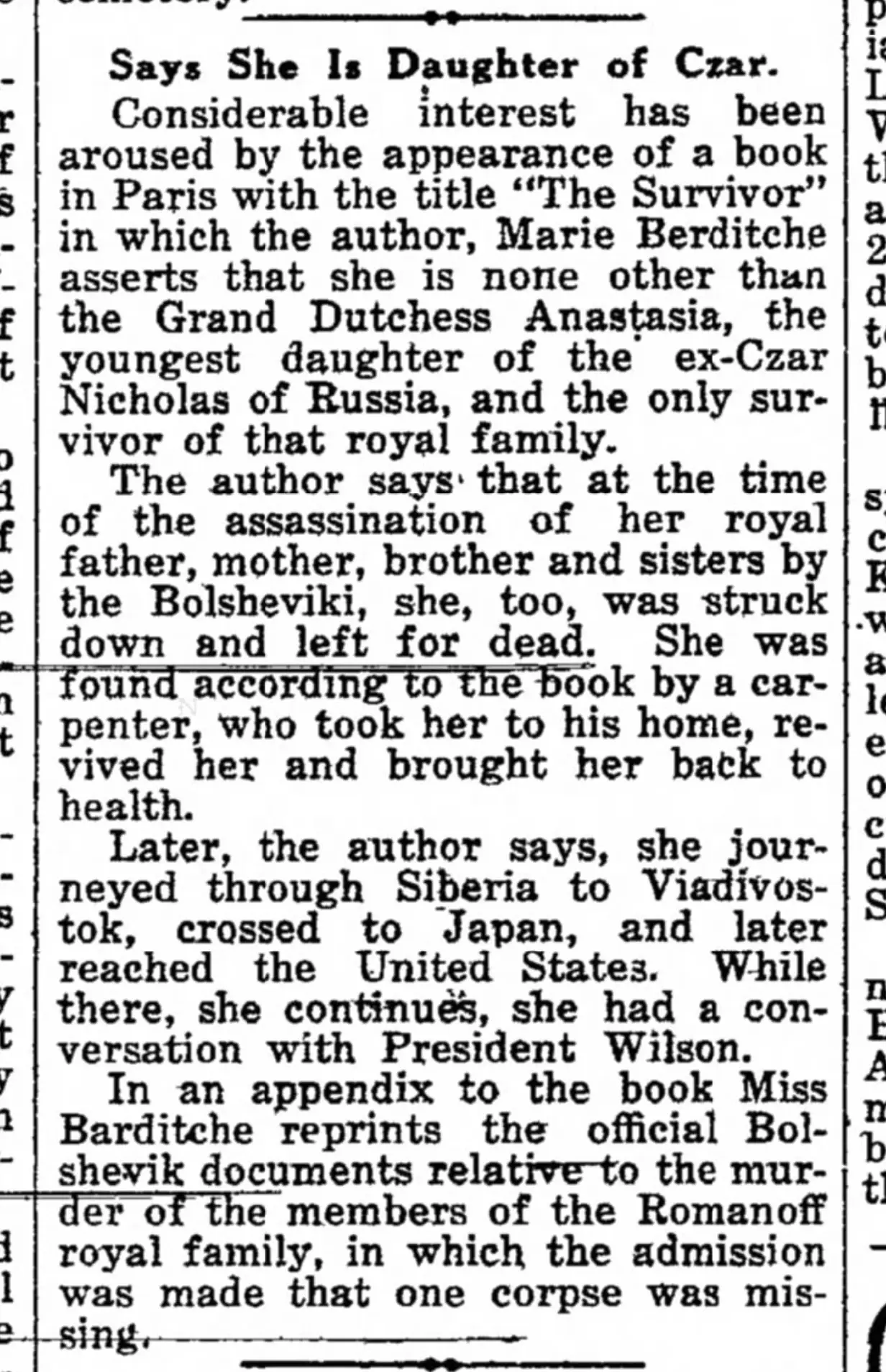
"Says She Is Daughter of Czar."
Considerable interest has been aroused by the appearance of a book in Paris with the title “The Survivor” in which the author, Marie Berditche asserts that she is none other than the Grand Duchess Anastasia, the youngest daughter of the ex-Czar Nicholas of Russia, and the only survivor of that royal family.
The author says that at the time of the assassination of her royal father, mother, brother and sisters by the Bolsheviki, she, too, was struck down and left for dead. She was found according to the book by a carpenter, who took her to his home, revived her and brought her back to health.
Later, the author says, she journeyed through Siberia to Vladivostok, crossed to Japan, and later reached the United States. While there, she continues, she had a conversation with President Wilson.
In an appendix to the book Miss Barditche reprints the official Bolshevik documents relative to the murder of the members of the Romanoff royal family, in which the admission was made that one corpse was missing.
OMAHA WORLD-HERALD
AUGUST 7, 1927
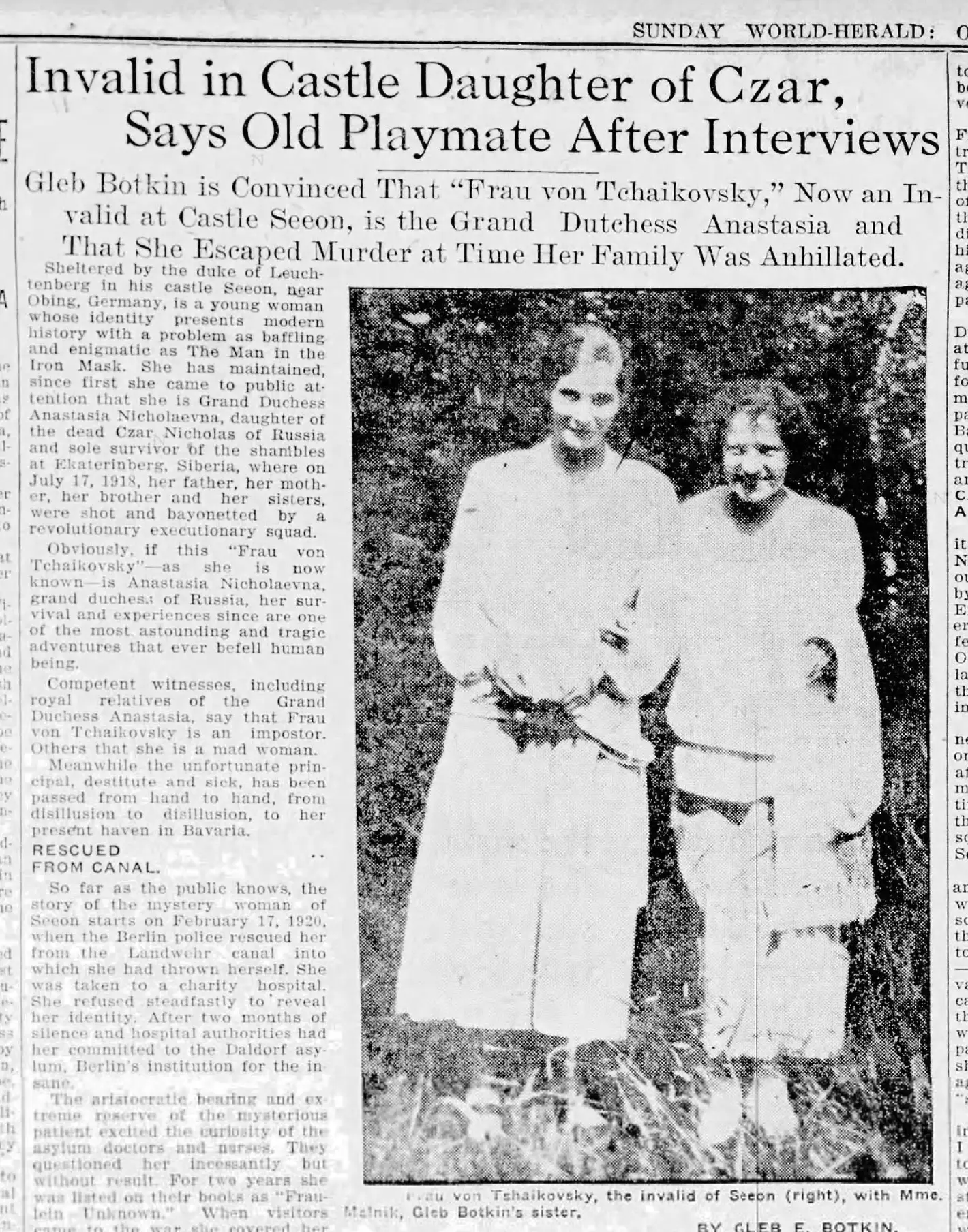
"Invalid in Castle Daughter of Czar, Says Old Playmate After Interviews:
Gleb Botkin is Convinced That “Frau von Tchaikovsky,” Now an Invalid at Castle Seeon, is the Grand Duchess Anastasia and That She Escaped Murder at Time Her Family Was Annihilated."
Sheltered by the duke of Leuchtenberg in his castle Seeon, near Obing, Germany, is a young woman whose identity presents modern history with a problem as baffling and enigmatic as The Man in the Iron Mask. She has maintained, since first she came to public attention that she is Grand Duchess Anastasia Nicholaevna, daughter of the dead Czar Nicholas of Russia and sole survivor of the shambles at Ekaterinberg, Siberia, where on July 17, 1918, her father, her mother, her brother and her sisters, were shot and bayonetted by a revolutionary executionary squad.
Obviously, if this “Frau von Tchaikovsky”—as she is now known—is Anastasia Nicholaevna, grand duchess of Russia, her survival and experiences since are one of the most astounding and tragic adventures that ever befell human being.
Competent witnesses, including royal relatives of the Grand Duchess Anastasia, say that Frau von Tchaikovsky is an impostor. Others that she is a mad woman.
Meanwhile the unfortunate principal, destitute and sick, has been passed from hand to hand, from disillusion to disillusion, to her present haven in Bavaria.
RESCUED FROM CANAL.
So far as the public knows, the story of the mystery woman of Seeon starts on February 17, 1920, when the Berlin police rescued her from the Landwehr canal into which she had thrown herself. She was taken to a charity hospital. She refused steadfastly to reveal her identity. After two months of silence and hospital authorities had her committed to the Daldorf asylum, Berlin's institution for the insane.
The aristocratic bearing and extreme reserve of the mysterious patient excited the curiosity of the asylum doctors and nurses. They questioned her incessantly but without result. For two years she was listed on their books as “Fraulein Unknown.” When visitors came to the ward she covered her head and turned her face to the wall.
One night a nurse who had been especially kind and tactful was approached by the mysterious patient. In her hand was an old copy of a German illustrated magazine containing a picture of the czar's family. The patient asked the nurse if she saw anything curious in the picture. The nurse did not. “Fraulein Unknown” then pointed to one of the Czar's daughters in the group and asked if she observed anything striking about it. After looking at the picture for some moments, the nurse was struck with the resemblance between the patient and the czar's daughter. At this point the night watchman entered the ward. “Fraulein Unknown” sprang back into bed covering her face until he was gone. Several hours later she again rose and in a state of violent excitement told the nurse the story of the Russian imperial family's execution in detail.
Later a Frau Peuthert, a patient at the asylum, declared the unknown fraulein to be a grand duchess.
On leaving the asylum in 1922, Frau Peuthert spread the news among the Russian emigres of Berlin that “Fraulein Unknown” was the grand duchess. They urged her to leave the asylum and take shelter with a Russian family. The hospital authorities agreed to this. They had never considered her insane.
THE MYSTERY WOMAN'S STORY.
From the spring of 1922 until late in 1924, still weak and ill, the putative Anastasia lived with Russian refugees. Some sought to establish her identity, others gambled for the prestige of exhibiting her. Her story or her experiences as evolved bit by bit was as follows:
On the night of the Ekaterinberg execution Anastasia, the czar and czarina, the Grand Duchess Olga, Tatiana and Marie, and the czarevitch, together with Dr. Eugene Botkin, personal physician to the imperial family, were awakened and ordered into a single room of the house where they were held prisoners of the bolsheviks. The leader of the bolshevik firing squad shot her father through the head with a revolver. Immediately the other bolsheviks began shooting the prisoners. She fainted and remembered nothing more until she came to consciousness some days later in a cart filled with straw.
With her were two young men, one in the uniform of a red guard, and two women. The red guard, a Pole, said his name was Tchaikovsky. He told her that he had been sent by the bolsheviks from his small farm near the city and forced to enter the red service. He said that after the shooting he had discovered she was still living and he had thrown a bundle of rags over her to prevent her from being carried off with the bodies of the dead.
He told her that the cremation and burial squad of bolsheviks had been in a great hurry to get its work done, because the White Russians were advancing on the city.
Associated press
February 9 1928
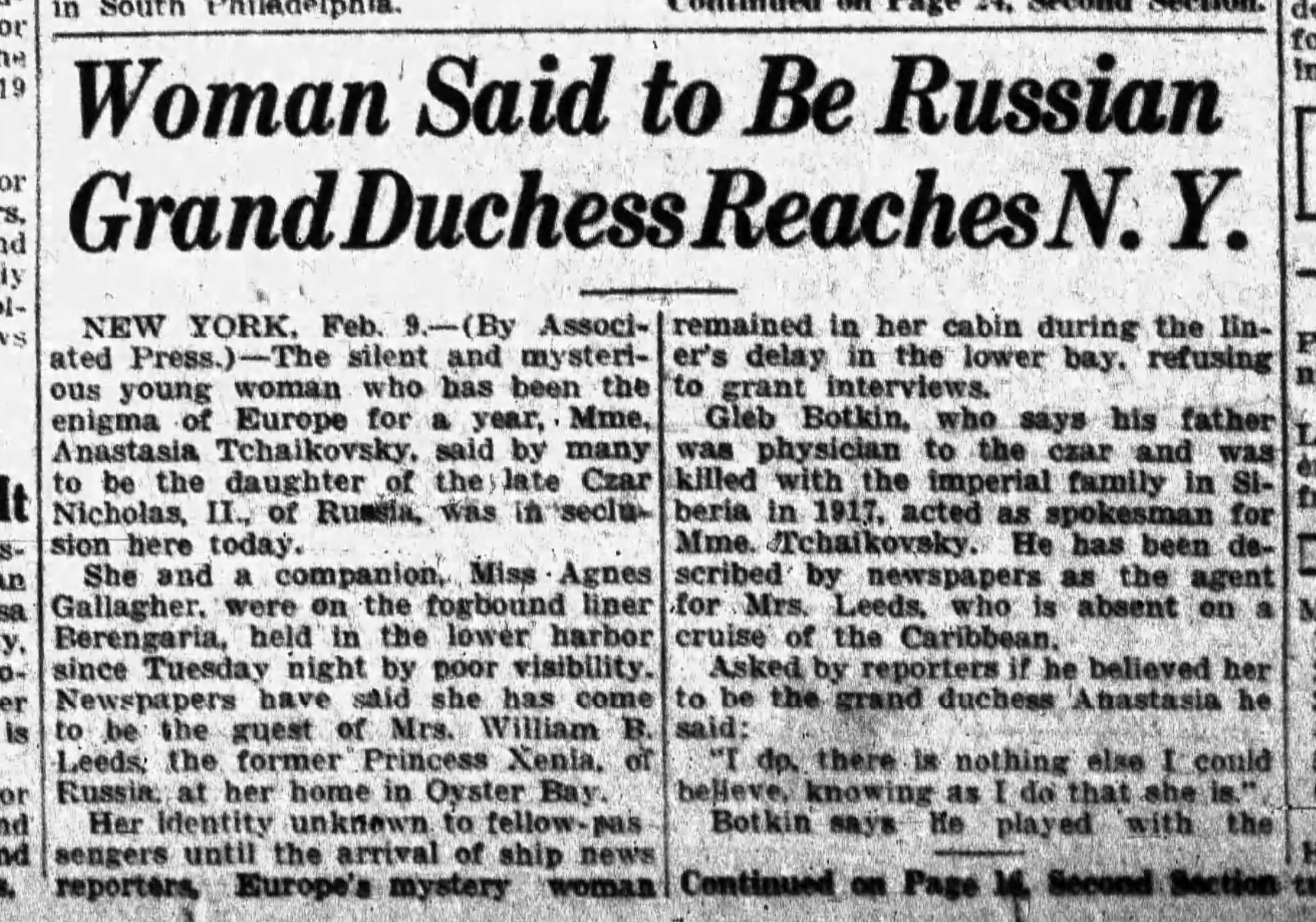
"Woman Said to Be Russian Grand Duchess Reaches N. Y."
The silent and mysterious young woman who has been the enigma of Europe for a year, Mme. Anastasia Tchaikovsky, said by many to be the daughter of the late Czar Nicholas II, of Russia, was in seclusion here today.
She and a companion, Miss Agnes Gallagher, were on the fogbound liner Berengaria, held in the lower harbor since Tuesday night by poor visibility. Newspapers have said she has come to be the guest of Mrs. William B. Leeds, the former Princess Xenia, of Russia, at her home in Oyster Bay.
Her identity unknown to fellow-passengers until the arrival of ship news reporters, Europe's mystery woman remained in her cabin during the liner's delay in the lower bay, refusing to grant interviews.
Gleb Botkin, who says his father was physician to the czar and was killed with the imperial family in Siberia in 1917, acted as spokesman for Mme. Tchaikovsky. He has been described by newspapers as the agent for Mrs. Leeds, who is absent on a cruise of the Caribbean.
Asked by reporters if he believed her to be the grand duchess Anastasia he said:
"I do, there is nothing else I could believe, knowing as I do that she is."
Botkin says he played with the Grand Duchess Anastasia when he was 8 and she was 7; that he was with her when the imperial family was exiled to Siberia, where the family was killed by Bolshevik guards. The grand duchess, one version says, was saved by a young soldier named Tchaikovsky, with whom she fled to Rumania and whom she later married.
W. W. Doulmistrow, president of the Russian Refugee Relief Society of America, issued a statement saying he had received a cable from the Grand Duchess Olga Alexandrovna, of Russia, now residing in Copenhagen, emphatically denying that Mme. Tchaikovsky is the Grand Duchess Anastasia.
The grand duchess Olga, sister of the late czar, visited Mme. Tchaikovsky while she was a patient in a German hospital, the statement says.
During the trip across Mme. Tchaikovsky took dinner in the dining saloon a few times, but did not mingle with the other passengers. One of the stewards who served her said that a waiter was forced to cut her meat for her, as she seemed to have suffered a completed paralysis of the right arm. He described her as a slender woman of medium height who seldom spoke. He remarked that she did "not seem quite as if she were aware what was going on about her." She always thanked him for the meal, he said.
Speaks Only in German.
Mme. Tchaikovsky is 26 years old and speaks only in German. Botkin explains this by the fact that she suffered a loss of memory from the terrible experiences she went through when she escaped the fate of the rest of the imperial family and does not remember her Russian.
The children of the late czar were all well schooled in German and English, in addition to their native tongue.
Botkin said that Mme. Tchaikovsky came to this country for a rest and to receive medical and dental treatment. Her jaw had been broken at one time and badly reset. She says it was caused by a blow from the butt of a guard's rifle in Siberia.
Through special arrangements, the medical and immigration authorities interviewed the Russian woman in her room, instead of with the other passengers. They said she answered only one question direct, that as to the length of her stay in this country. She said she would be here eight months. All other questions she wearily referred to her nurse.
Brooklyn EAGLE
Wed, Oct 31, 1928
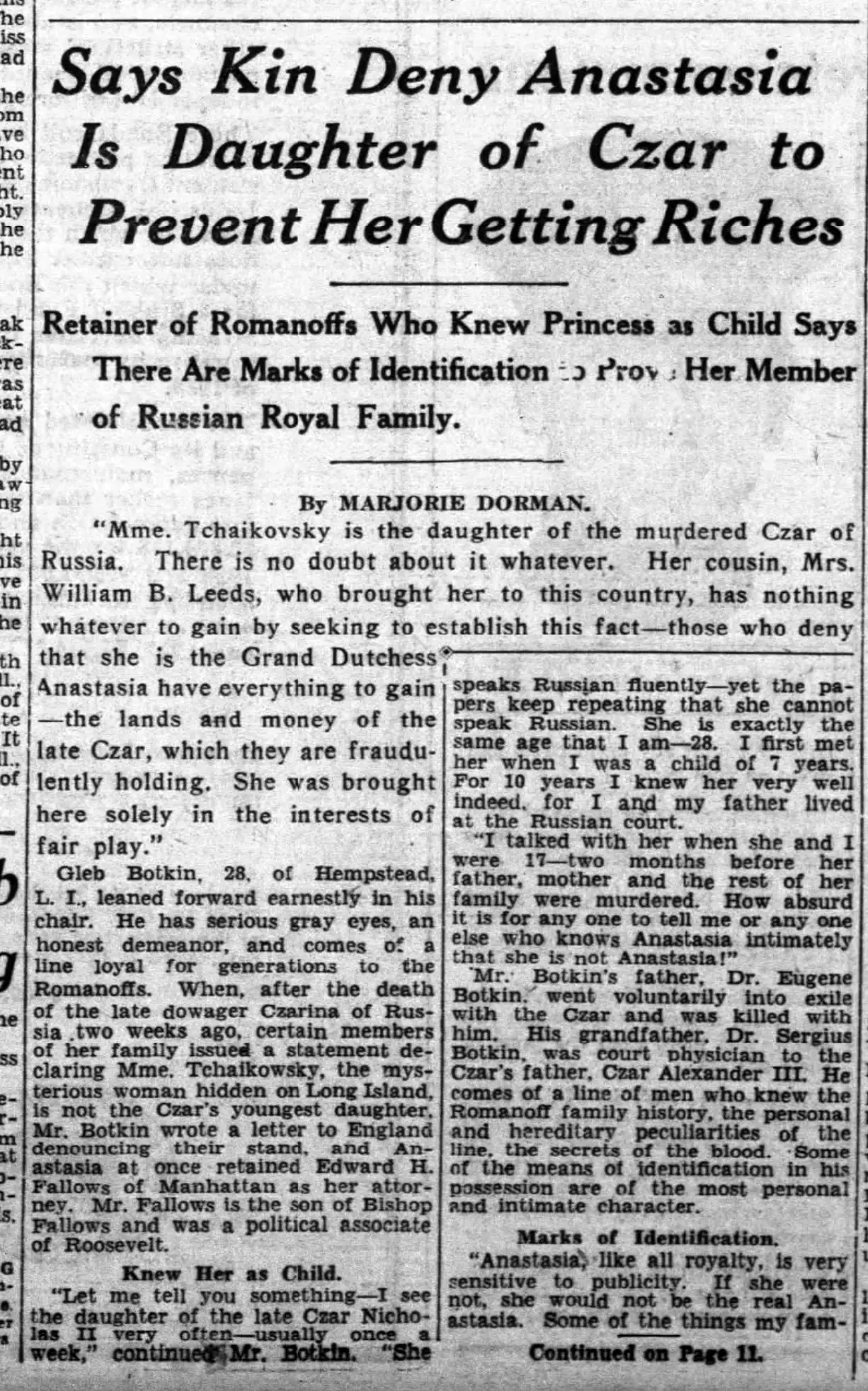
"Says Kin Deny Anastasia Is Daughter of Czar to Prevent Her Getting Riches: Retainer of Romanoffs Who Knew Princess as Child Says There Are Marks of Identification to Prove Her Member of Russian Royal Family."
By MARJORIE DORMAN.
“Mme. Tchaikovsky is the daughter of the murdered Czar of Russia. There is no doubt about it whatever. Her cousin, Mrs. William B. Leeds, who brought her to this country, has nothing whatever to gain by seeking to establish this fact—those who deny that she is the Grand Duchess Anastasia have everything to gain—the lands and money of the late Czar, which they are fraudulently holding. She was brought here solely in the interests of fair play.”
Gleb Botkin, 28, of Hempstead, L. I., leaned forward earnestly in his chair. He has serious gray eyes, an honest demeanor, and comes of a line loyal for generations to the Romanoffs. When, after the death of the late dowager Czarina of Russia two weeks ago, certain members of her family issued a statement declaring Mme. Tchaikovsky, the mysterious woman hidden on Long Island, is not the Czar’s youngest daughter, Mr. Botkin wrote a letter to England denouncing their stand, and Anastasia at once retained Edward H. Fallows of Manhattan as her attorney. Mr. Fallows is the son of Bishop Fallows and was a political associate of Roosevelt.
Knew Her as Child.
“Let me tell you something—I see the daughter of the late Czar Nicholas II very often—usually once a week,” continued Mr. Botkin. “She speaks Russian fluently—yet the papers keep repeating that she cannot speak Russian. She is exactly the same age that I am—28. I first met her when I was a child of 7 years. For 10 years I knew her very well indeed, for I and my father lived at the Russian court.
“I talked with her when she and I were 17—two months before her father, mother and the rest of her family were murdered. How absurd it is for any one to tell me or any one else who knows Anastasia intimately that she is not Anastasia!”
Mr. Botkin’s father, Dr. Eugene Botkin, went voluntarily into exile with the Czar and was killed with him. His grandfather, Dr. Sergius Botkin, was court physician to the Czar’s father, Czar Alexander III. He comes of a line of men who knew the Romanoff family history, the personal and hereditary peculiarities of the line, the secrets of the blood. Some of the means of identification in his possession are of the most personal and intimate character.
Marks of Identification.
“Anastasia, like all royalty, is very sensitive to publicity. If she were not, she would not be the real Anastasia. Some of the things my family knew and I know I shall ask you not to publish. But this you can say:
“When a young girl she had a mole burned off her shoulder—and the scar remains of that mole. As a child she caught her left hand in a carriage door—and that mark is on one of the fingers of her left hand. There are other similar means of identification that cannot be controverted.
“Anastasia is being persecuted by two groups in Europe and that is why Mrs. Leeds brought her here to rest. She is far better than she was. While extremely nervous, she is absolutely normal mentally. Do you think it would be possible for me to talk with this girl whom I have known since childhood and be deceived? That is preposterous.
“The groups which have circulated the absurd stories about her being a Pole and unable to speak Russian are, I regret to have to say, the members of her own family who are holding her fortune. We are not so interested in the fortune as we are in establishing her identity before the world—but the fortune is what holds the entire interest of those opposing her.
Blames Grand Duke.
“The strongest opposition comes from Germany, from her uncle on her mother’s side, the Grand Duke Ernest Ludwig Hessen Darmstadt, brother of Alexandra. Hessen Darmstadt is in a difficult position because, during the World War, he was of the German high command. When Anastasia was asked when she last saw him she broadcast the fact that he was in Tsarksoe Selo in 1916 for a 24-hour visit to her father.
“This made Hessen Darmstadt furious, because he had secretly come to see if he could negotiate a separate peace for his little principality. Anastasia was too honest—and his entire political career is in the balance. He immediately repudiated her.
“He at once embarked on a campaign to prove her someone else. He had already taken over all his sister’s lands and he knew these would have to be relinquished, but it was his political rather than his financial loss which concerned him. He started the Polish myth and by securing control of a German newspaper got his campaign launched. Even now the American newspapers pick up some of the malicious misinformation originated by his newspaper and taken up by others all over the world. He is powerful and he fights for his own political future.
“The other group is headed by the Grand Duchess Xenia Alexandrovna, who lives at Windsor Castle, England. She is the daughter of the Dowager Empress Marie Fedorovna, and no sooner did the Empress die than this woman issued the proclamation that Anastasia is not Anastasia.
“Do you know who signed this pronunciamento to the press? Herself, her husband, her sister and her six children, and two of her first cousins.
“These two groups, because each is already in possession of considerable property of the late Czar, have engaged in a slanderous campaign against Anastasia—and it is to defend herself that she has now retained a lawyer. Neither group can acknowledge her now without being guilty of fraud in the courts of Germany and England.
“Mrs. Leeds, Mr. Fallows and I have a tremendous volume of proof to submit when Anastasia is strong enough to face the courts and establish her identity. Until that time she will remain in seclusion on Long Island. Mr. Fallows sees her constantly, so do I and Mrs. Leeds and a small group of Americans and Russians who guard her against unwelcome intrusions.”
No Throne Ambitions.
“Does she intend to try to regain the Romanoff throne?”
“She could not if she wished—the Russian law is that a woman may only inherit when the male line has been exterminated. As long as male cousins survive no woman could sit on the throne of the Romanoffs.”
“Anastasia is defenseless. It is a shameful thing that in the break-up of Russia a woman could find herself in such a position with the unscrupulous members of her own blood so eager to hold on to wrongfully seized wealth that they refuse to accept proofs when they are offered to them.”
Mr. Fallows summed up his attitude to Anastasia by saying:
“This is not a case to me—it is a cause. I am convinced, after talking with her cousin, Mrs. Leeds, the Princess Zenia of Russia, to Mr. Botkin and to the Grand Duchess Anastasia, that she is the daughter of the late Czar Nicholas II.
Finds Handwriting the Same.
“Anastasia, at 28, is not very different from the Anastasia of 17. Her handwriting is the same and in appearance she has changed so little that a photograph taken now, compared with one taken then, is remarkably like. There exist most convincing documents regarding her entire life before coming to America which will be submitted at the proper time.
“All the physicians who have ever attended Anastasia are agreed that she is herself and none other. But the groups opposing us will stop at nothing to gain their ends and we must be sure that Anastasia is strong enough to endure what she must face.”
Historical note: This article concerns Anna Anderson, who claimed to be Grand Duchess Anastasia Nikolaevna, daughter of Czar Nicholas II. The article reports the assertions of Anderson's supporters, particularly Gleb Botkin and attorney Edward H. Fallows. Subsequent DNA testing established that Anderson was not Anastasia.
The transcription is complete for the five supplied clippings, though I have normalized punctuation in a few places where the print was unclear.
ASSOCIATED PRESS
JULY 30, 1929
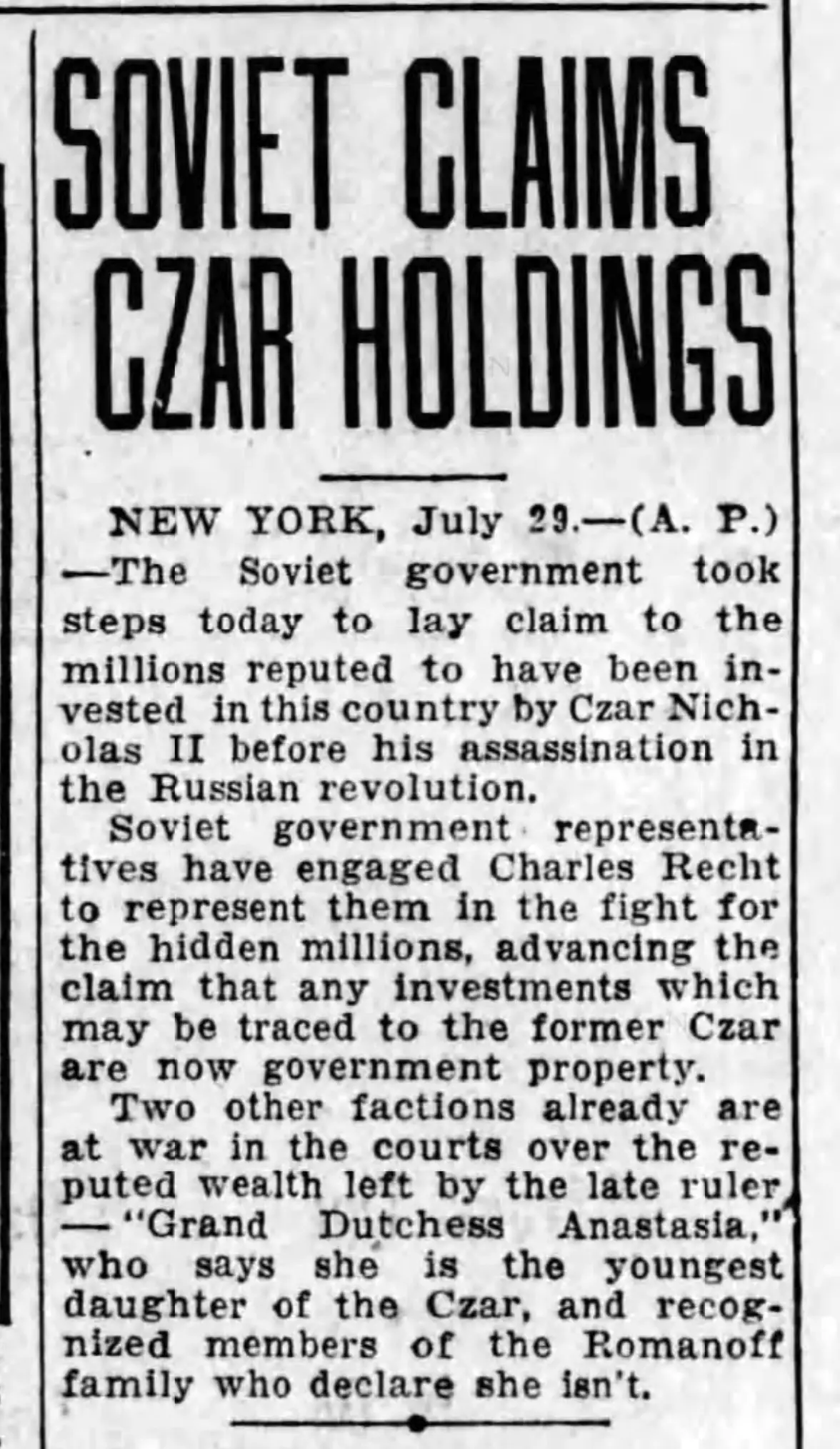
"SOVIET CLAIMS CZAR HOLDINGS"
The Soviet government took steps today to lay claim to the millions reputed to have been invested in this country by Czar Nicholas II before his assassination in the Russian revolution.
Soviet government representatives have engaged Charles Recht to represent them in the fight for the hidden millions, advancing the claim that any investments which may be traced to the former Czar are now government property.
Two other factions already are at war in the courts over the reputed wealth left by the late ruler—“Grand Duchess Anastasia,” who says she is the youngest daughter of the Czar, and recognized members of the Romanoff family who declare she isn't.