
Anastasia: A Timeline OF HISTORICAL EVENTS AND ANASTASIA IMPOSTORS
(Warning: This timeline contains historical details some may find upsetting.)
February 23, 1917: Mass protests begin in St. Petersburg after the rapid fall of the economy and the rationing of food ordered by Russian Czar Nicholas II (of the Romanov dynasty, emperor of Russia from 1894-1917). This is known as the February Revolution, following a series of staggering Russian military defeats before and during World War II.
March 15, 1917: Nicholas II (Nicholas Romanov) abdicates the throne, ending three centuries of reign by the Romanov family. A provisional government is established.
March 20, 1917: The Russian Provisional Government places the Romanov family under house arrest in their home, Alexander Palace, just south of St. Petersburg,
July 16-20, 1917: After it escalates Russia’s role in the world war, the first violent protests against the Russian Provisional Government take place.The government blames the growing Bolshevik party, which advocates a war of the working class against capitalism.
August 19, 1917: The Romanov family is moved 1,300 miles from the extravagant Alexander Palace in St. Petersburg to the Governor’s Mansion in Tobolsk in central Russia, far away from the growing protests.
October 25, 1917: After the failure of the Russian Provisional Government to withdraw from the World War (as well as a July government protest that killed hundreds of industrial workers and military veterans), the Bolshevik party, led by Vladimir Lenin, begins the overthrow of the Russian Provisional Government with the support and might of armed industrial workers and a large contingency of the Russian Army. After an assault on their headquarters (the White Palace in St. Petersburg), the Russian Provisional Government surrenders.
October 31, 1917: Despite much public opposition, the Boksveviks take control of Moscow after a week of deadly street fighting in which 700 are killed. The Bolsheviks suppress political dissent and assert dominance by establishing a secret police force (The Cheka) and carrying out mass executions. This is the beginning of a Russian civil war that will last until 1922. Nicholas Romanov follows the news with interest but without alarm.
March 3, 1918: Russia officially exits World War I when the Bolshevik government signed the Treaty of Brest-Litovsk, relinquishing 1 million square miles to enemies Germany, Austra-Hungary and Turkey.
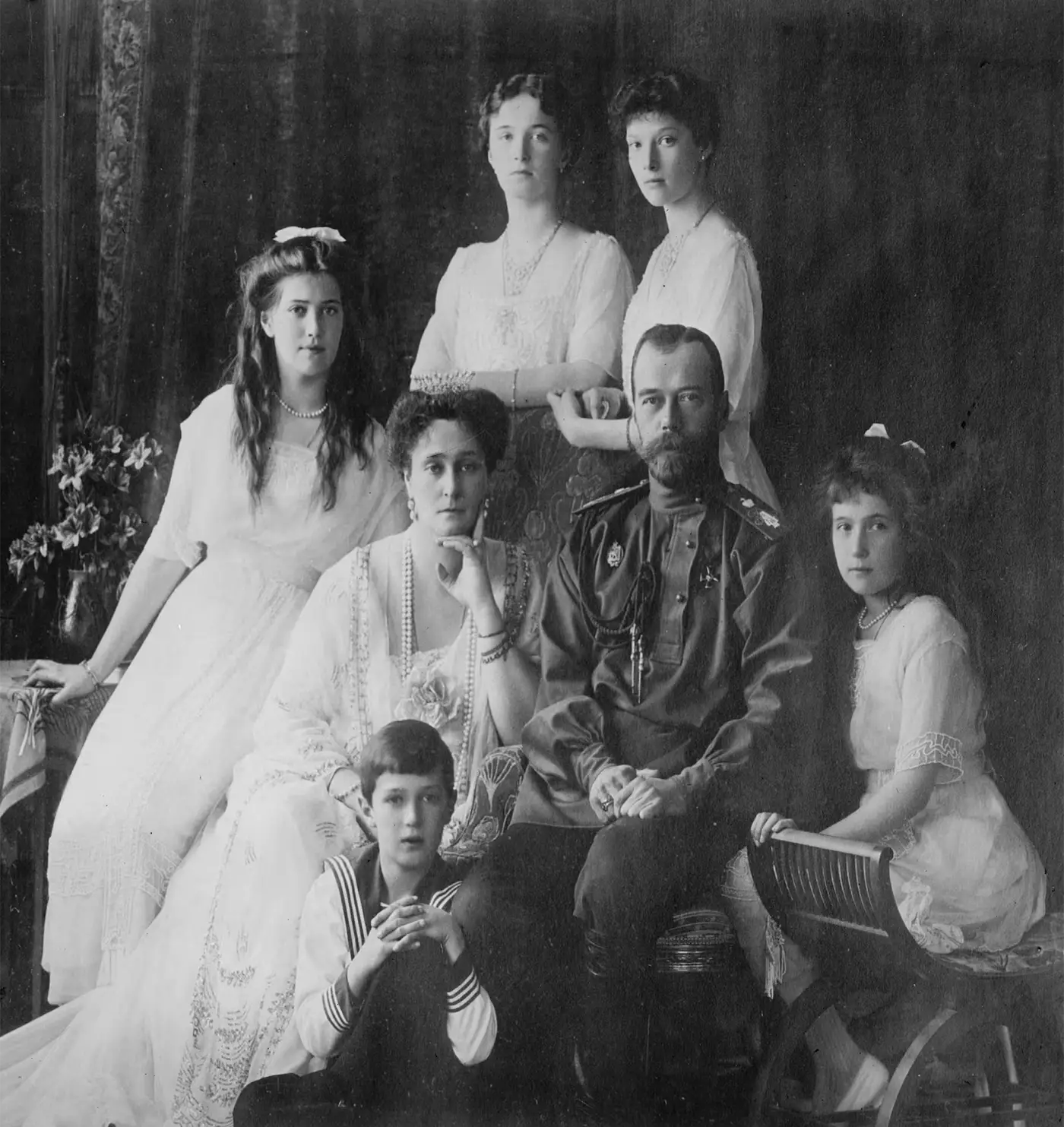
Romanov family photo
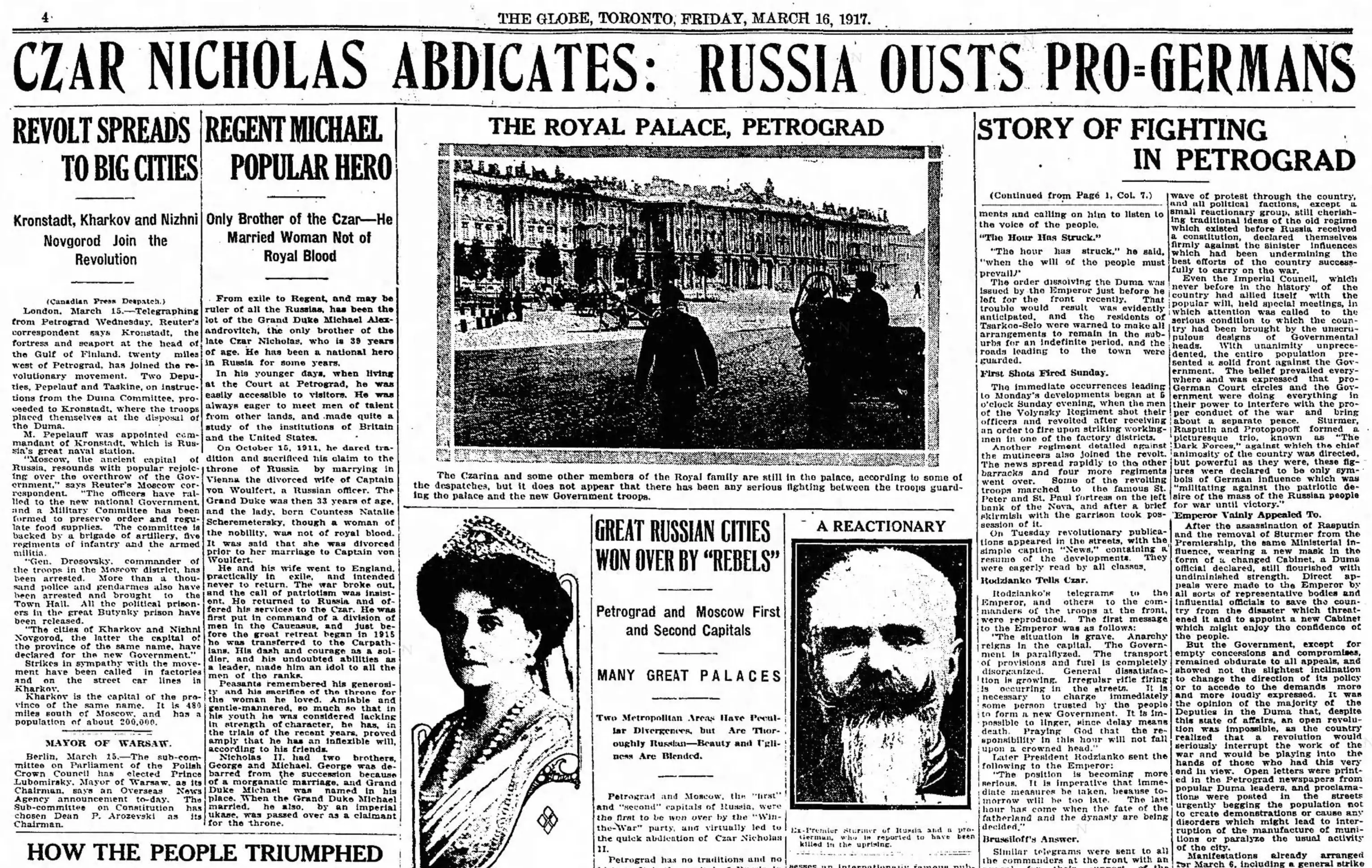
Toronto Globe, March 1917
March 23, 1918: The Bolsheviks begin moving the Romanov family to Yekaterinburg, closer to Moscow, The journey takes a month due to changing order and worries of a plot to rescue the family and take them out of the country. Some of the children remain in Tobolsk due to illness, in the care of their teachers.
April 25, 1918: The Romanav family arrives in Yekaterinburg. They are imprisoned in a modest, 2-story home. A fence is constructed around the home and the windows are painted shut. Members of the Cheka secret police arrive to guard the family. Nicholas finally shows fear.
May 23, 1918: The entire Romanov family is reunited as the children who were left behind in Tobolsk finally arrive.
June 29, 1918: Members of the Bolshevik hierarchy begin discussions of what to do with the Romanov family, including execution to end any legitimacy of the royal lineage.
July 16, 1918: An anti-Bolshevik military garrison was quickly advancing on Yekaterinburg. Although the Bolsheviks had planned on bringing Nicholas Romanov to trial, it is decided to murder the family immediately. Who gave the actual order is often disputed, but there is no written public record of the order of execution.
July 17, 1918: Nicholas Romanov and his family (wife Alexandra, and children Olga, Tatiana, Maria, Anastasia, and only son Alexei) are awakened in the middle of the night, walked to a basement room and are executed. The executioners find a trove of jewels that had been sewn into their clothing. Four members of the Romanov staff are also executed. All the bodies are mutilated and buried in a nearby forest. The Bolsheviks announce Nicholas’ killing, but maintain a systematic campaign of disinformation over the next 8 years, frequently shifting blame for who killed who and when, and fueling rumors of survivors. The details of the execution are conflicting based on subsequent testimonies by the executioners themselves.
July 18, 1918: Other members of the extended Romanov family still living in Russia are killed, including a grand daughter of Britain’s Queen Victoria.
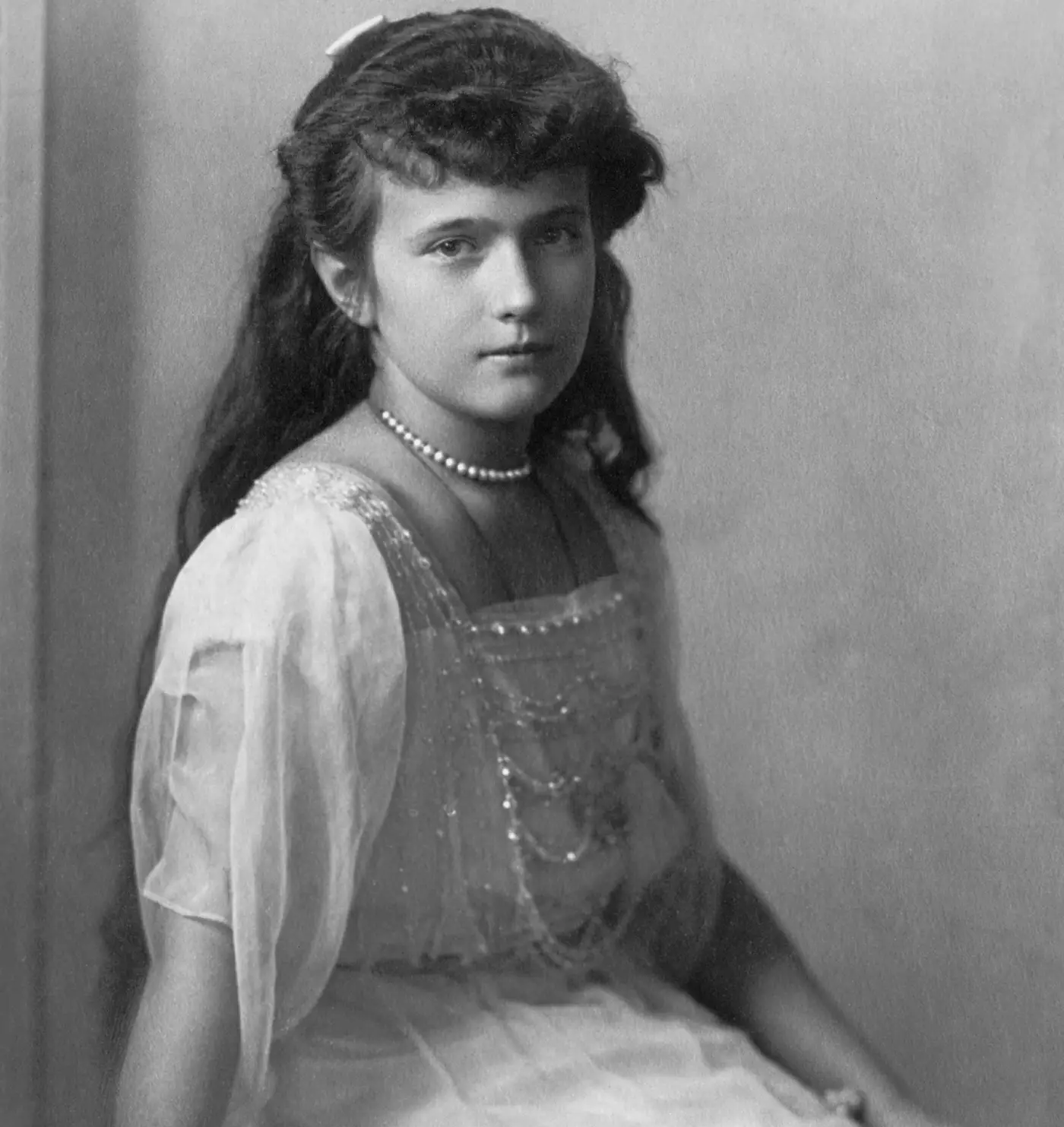
Anastasia Romanov, aka Grand Duchess Anastasia Nikolaevna (Nikolaevna means "daughter of Nicholas")
1919: Dowager Empress Maria Feodorovna, mother of Nicholas Romanov, escapes Russia aboard the British ship HMS Marlborough sent by her nephew, King George V. She had been living in remove Crimea and had been out of the Bolshevik’s reach. Born in Denmark, she had been Empress of Russia from 1881-1894 as the wife of Emperor Alexander III.
1922: The remaining royal jewels recovered after the execution (many were stolen on that day) are catalogued and stored away. Some of the collection is sold in 1927 by the government for cash at an auction by Christie’s in London.
December 1922: The Bolshevik regime officially establishes the Soviet Union (USSR) after bringing an end to the 5-year Russian Civil War, during which numerous pockets of resistance rose across Russia to challenge Bolshevik rule.
December 30, 1922: Despite his ill health, Vladimir Lenin is elected Premier of the Soviet Union. He serves until his death on January 21, 1923 at he age of 53.
March 1922: Anna Anderson (born Franziska Schanzkowska, 16 December 1896) makes claim to be the surviving Grand Duchess Anastasia Romanov. Her claim was supported by a childhood friend of Anastasia, Gleb Botkin, the son of the Romanov family’s personal physician, and one of the staff who was executed in Yekaterinburg on July 17, 1918.
1922: A young woman, Eleanor Kruger arrives in Gabarevo, Bulgaria, alongside her younger brother George, and live among Russian settlers in the community. Villagers often discussed that due to her formal speech and advanced knowledge of the arts and culture that she had to have been of royal birth. Some specifically theorized and promoted the belief that Eleanor and George were actually Anastasia and Alexei smuggled out of Russia by a loyal soldier. There is zero proof of this theory and Eleanor and George themselves never made any claims as such.
1926: The Soviet regime finally acknowledges the killings of the entire family after a French newspaper published an independent investigation into the murders.
1928: Dowager Empress Maria Feodorovna dies in her native Denmark. Until her death she publicly refused to believe her son and grandchildren had been murdered, also fueling rumors of Anastasia’s survival. She publicly refuted Anna Anderson’s claim to be Anastasia.
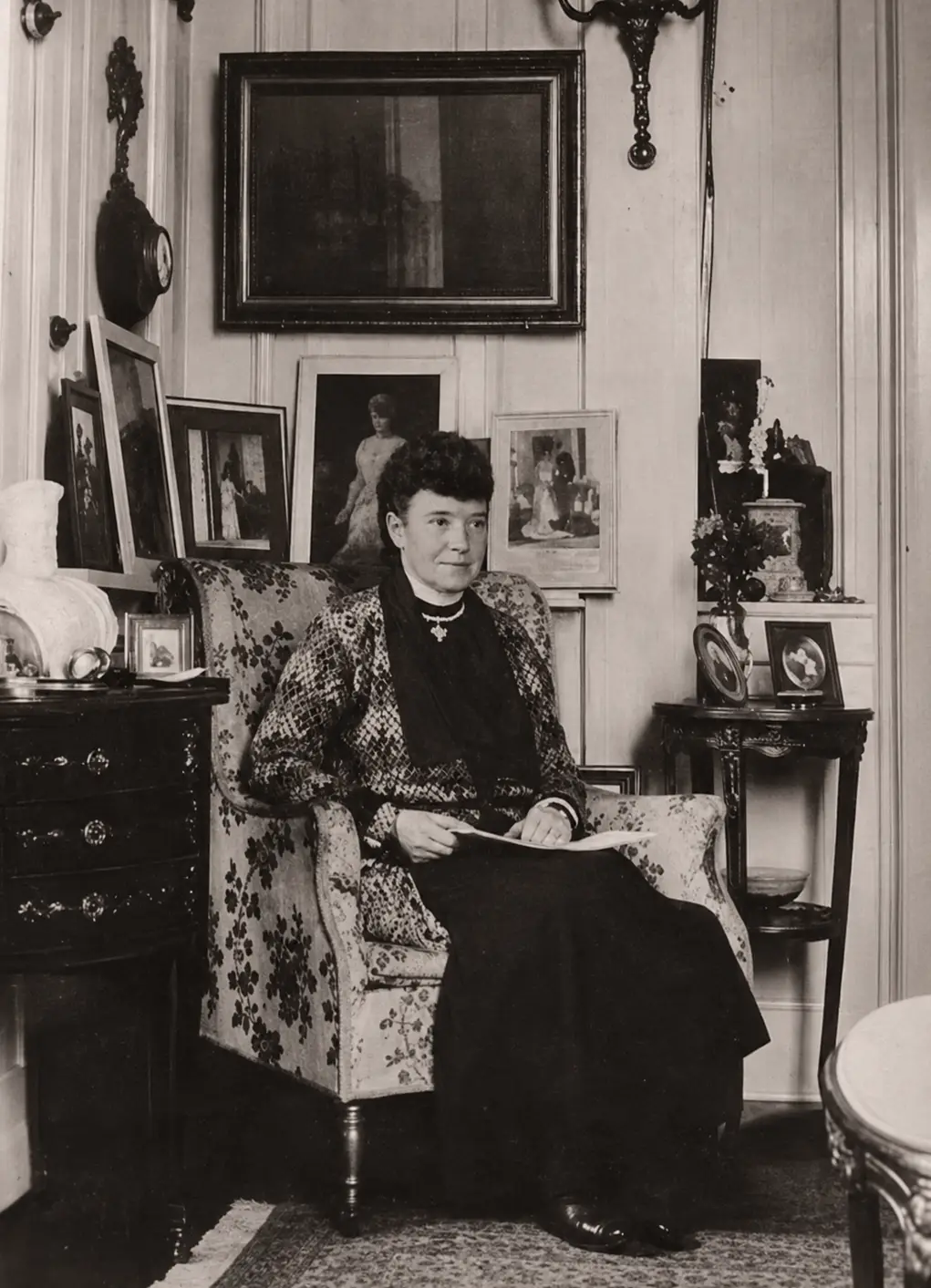
Dowager Empress Maria Feodorovna
1934: A woman in a Russian prison hospital, Nadezhda Vasilyeva, writes to King George V proclaiming to be his cousin, Anastasia. She makes the claim until her death in an “insane asylum” in 1971.
1963: Eugenia Smith publishes an autobiography in which she claims to be Anastasia Romanov under the title Anastasia: The Autobiography of H.I.H. The Grand Duchess Anastasia Nicholaevna of Russia. Smith began making claims as early as 1922 that she was Anastasia. Surviving relatives of the Romanovs living in the United States, who themselves knew Anastasia as a child, repeatedly refuted her claim.
1963: After Smith's book is published, an ex-Polish military officer, Michael Goleniewski, makes claims of being Alexei Romanov. Goleniewski had defected to the US after selling Polish and Russian military secrets to the CIA. After making the claim of being Alexi Romanov (despite being 18 years younger than Alexei) he was labeled an embarrassment by the CIA and was released of his employment and placed on a pension. Eugenia Smith first meets Goleniewski and publicly supports his claim, but later denounces him as a fraud.
1979: The Romanov burial site is discovered in Yekaterinburg.
July 1991: The remains found at the Romanov burial site are exhumed, but two bodies appear to be missing of the eleven individuals murdered on July 17, 1918. DNA testing confirms the remains belong to the five of the Romanovs and their staff. The bodies of two children are unaccounted for. The DNA of Glen Botkin’s daughter, Marina, was used to help identify the remains of her grandfather, Yevgeny Botkin.
December 26, 1991: The Soviet Union is formally dissolved.
July 17, 1998: The remains of the Romanov family are interred at St. Peter and Paul Cathedral in St. Petersburg. It is the 80th anniversary of their assassination. The ceremony was attended by Russian president Boris Yeltsin, who gave a speech at the funeral saying, "Today is a historic day for Russia. For many years, we kept quiet about this monstrous crime, but the truth has to be spoken."
June 2002: Russian television broadcasts video of a recently-deceased woman, Natalya Petrovna Bilikhodze, who claimed in the video interview to be Anastasia. She reportedly was seeking financial compensation.
August 2007: A second burial site is discovered nearby and the forensic remains account for all those murdered in 1918.
April 2008: DNA tests lead Russian forensic scientists to announce the remains discovered at the two burial sites are positively those of the previously unaccounted for Romanov children.
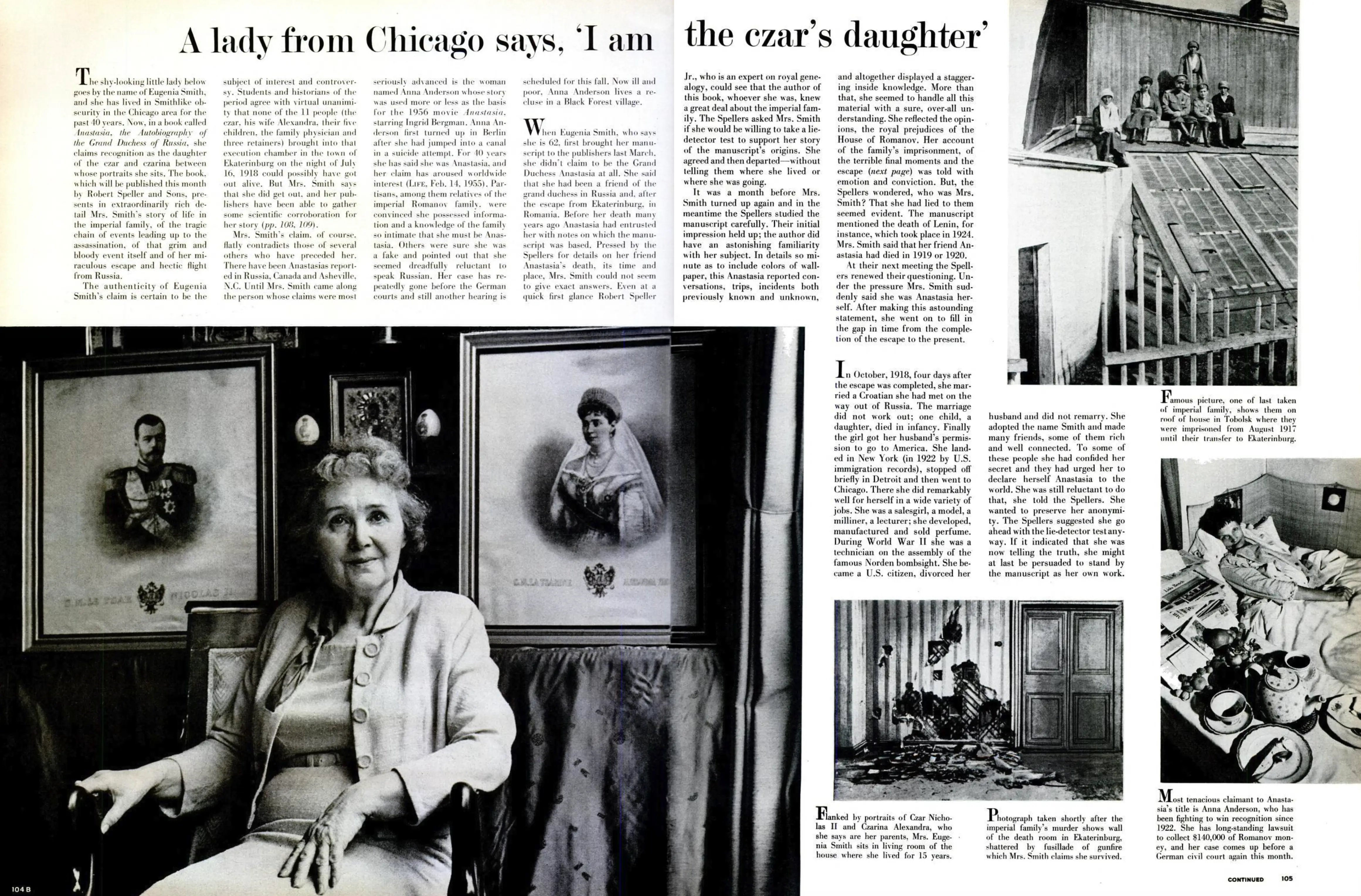
Life Magazine Article about Eugenia Smith (1963)
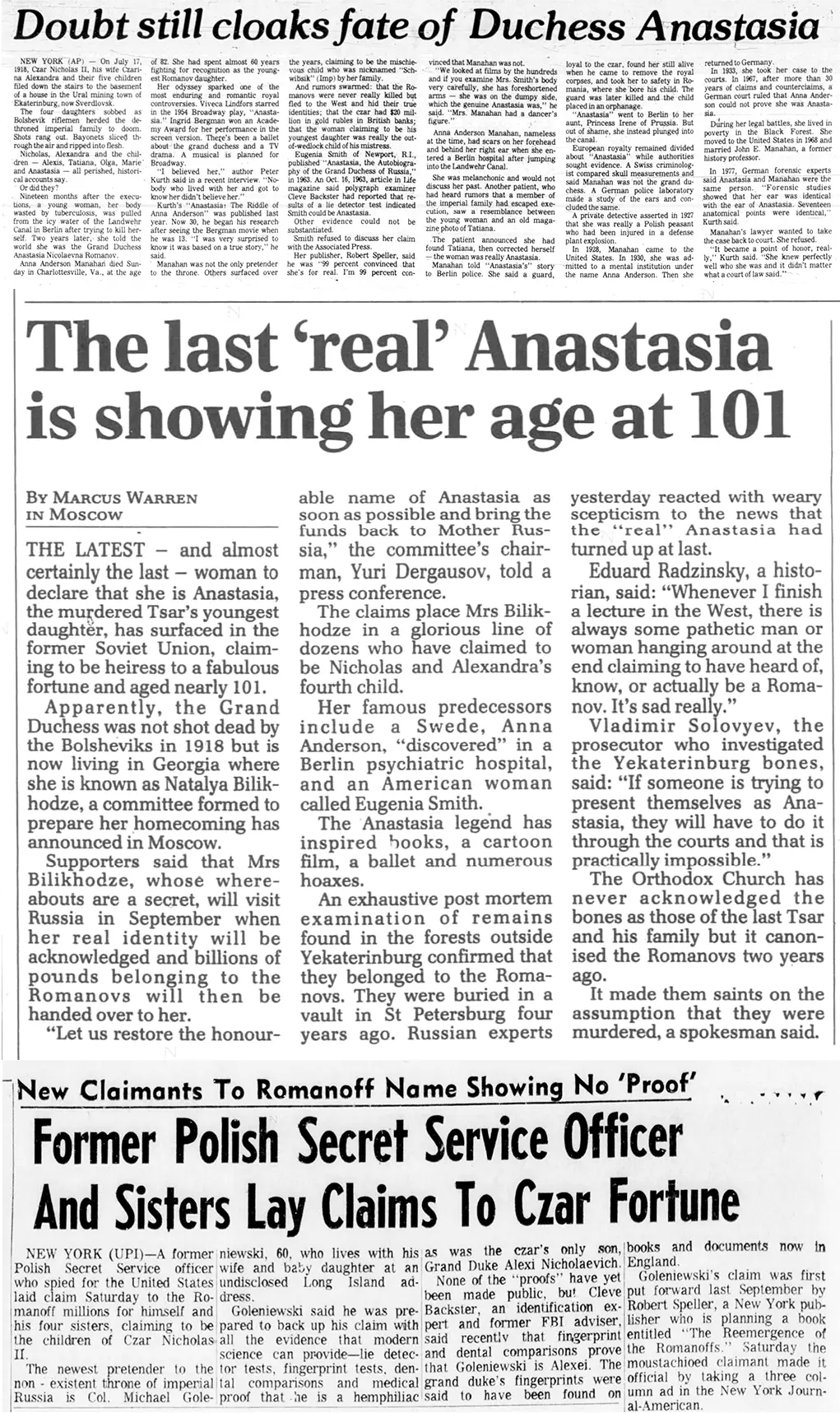
Assorted newspaper articles about Anastasia/Alexei imposters